Brand Reviews
Samsung Galaxy Watch 4 Review 2026: Still Worth It?
Samsung Galaxy Watch 4 review — Wear OS 3, Exynos W920, precise GPS, and BIA body composition. Here's what holds up in 2026 and where it falls short against newer options.
Samsung Galaxy Watch 4 review — Wear OS 3, Exynos W920, precise GPS, and BIA body composition. Here's what holds up in 2026 and where it falls short against newer options.
The Samsung Galaxy Watch 4 swaps the rotating bezel for a touch navigation system. And after removing this bezel, its design changes somewhat, impacting the weight, the size of the screen, the autonomy and even the look of the case. So what is the Watch 4 worth without its bezel?
Lets see in our expert review
[amazon fields=”B096BJLZZM” value=”thumb” image_size=”large” image_align=”center” image_alt=”Samsung Galaxy Watch 4 review”]
| screen size | 1.19 inches |
| Screen type | Super-AMOLED |
| Screen Resolution | 396 x 396 pixels |
| Screen Design Shape | Circular |
| Screen protection | Gorilla Glass DX+ |
| Touchscreen | Yes |
| Color screen | Yes |
Hardware Details
| Thickness | 9.8mm |
| Lenght | 39.3mm |
| Weight | 25.90 grams |
| Processor | Exynos W920 |
| RAM | 1.5 GB |
| Operating system | Wear OS 3 |
| Compatible Smartphones | Android |
| Storage capacity | 16 GB |
| Battery capacity | 247mAh |
| Autonomy | 24-36 hours |
Connectivity and Sensors Details
| SMS/MMS support | Yes |
| Call support | Yes |
| SIM type | eSIM |
| Bluetooth version | 5.0 |
| GPS | Yes |
| NFC | Yes |
| Wi-Fi version | 4 |
| Accelerometer and electronic compass | Yes |
| Ambient light sensor | Yes |
| Sleep analysis | Yes |
| Pedometer | Yes |
| heart rate sensor | Yes |
| SpO2 sensor | Yes |
[amazon fields=”B096BJLZZM” value=”thumb” image_size=”large” image_align=”center” image_alt=”Samsung Galaxy Watch 4 review”]
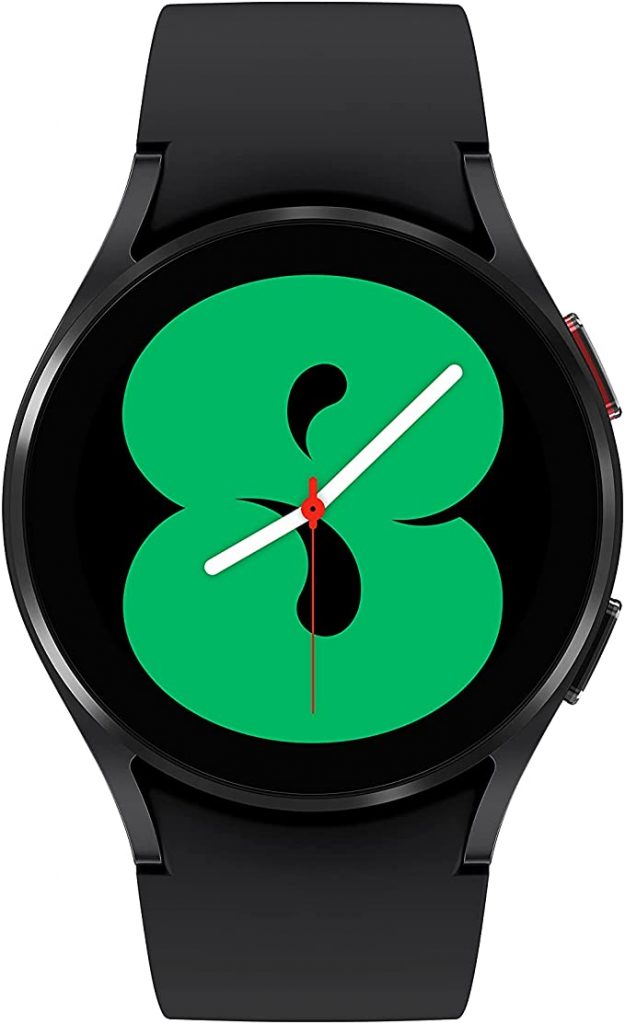
The design of the Galaxy Watch 4 differs from the Galaxy Watch 4 Classic, in that it has the rotating bezel and opts for a less domed design. Rather than turning the bezel, you navigate through the menus by touching the edges of the screen. This makes it possible to somewhat lighten the general aspect of the watch and avoids the liner side attached to the wrist, which is, in my humble opinion, a plus. And I say that when the model I tested is the 44mm version, and a smaller 40mm version is offered. Another advantage to this disappearance of the bezel: the screen is slightly larger than on the Galaxy Watch Classic.
This difference also allows the case of the Watch 4 to extend somewhat into on the bracelet, in a much more original look than that of the Watch Classic.
The 40 mm version of the Galaxy Watch 4 has a 1.2 inch screen, which displays a resolution of 396 x 396, while the version I tested, 44 mm, displays a 1.4 inch screen with a resolution of 450 x 450.
There is not much to add compared to the test of the classic model. We keep the OLED, the Gorilla Glass DX well and I’ve never had to complain about fingerprints left on this screen. The gain in size of the screen does not affect its resolution in any way and the brightness is also good, which makes it possible to use the watch in direct sunlight without any problem to your eyes.
The sports functions are the same as those present in the Watch 4 Classic. We thus find the standard of all that can be expected from a smartwatch in terms of monitoring physical activity. Pedometer, heart rate monitor, SpO2, electrocardiogram, integrated GPS, bio-impedance measurements, etc. All the sensors present on the Classic are there.
[amazon fields=”B096BJLZZM” value=”thumb” image_size=”large” image_align=”center” image_alt=”Samsung Galaxy Watch 4 review”]
One email a week. New guides and ranking changes, no fluff.